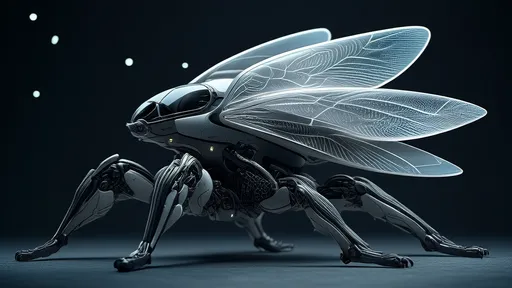
In a groundbreaking fusion of biology and engineering, researchers have successfully developed biohybrid drones powered by living insect muscles. These remarkable machines blur the line between natural organisms and artificial devices, opening new possibilities for micro-aerial vehicles that could outperform conventional drones in agility, efficiency, and environmental adaptability.
The concept of using biological components in robotics isn't entirely new, but the application of insect muscle tissue to achieve sustained flight represents a quantum leap forward. Scientists at the forefront of this technology have managed to culture and maintain dorsal-longitudinal muscles from beetles, connecting them to artificial wing structures through flexible polymer-based joints. When electrically stimulated, these muscle tissues contract and relax rhythmically, mimicking the natural wing movements observed in flying insects.
What makes this approach revolutionary is the unparalleled energy efficiency of biological muscles compared to synthetic actuators. Insect muscle tissue can produce significantly more power per unit weight than even the most advanced micro-motors while operating at a fraction of the energy cost. This efficiency breakthrough could solve one of the most persistent challenges in micro-drone design - limited flight duration due to battery constraints.
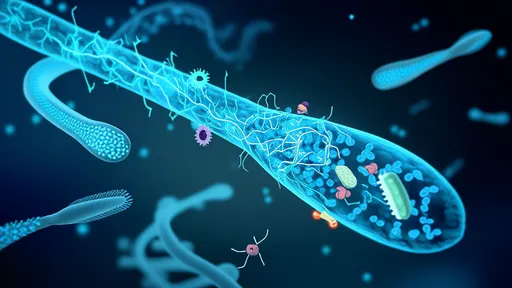
The development process hasn't been without hurdles. Maintaining living muscle tissue outside its natural biological environment requires precise control of temperature, humidity, and nutrient supply. Researchers have engineered microfluidic systems that continuously deliver oxygen and nutrients to the muscle tissues while removing metabolic waste products. These life-support systems add some weight to the drones but are offset by the superior performance of the biological actuators.
Flight control presents another fascinating challenge. Unlike conventional drones that rely on electronic speed controllers adjusting motor RPMs, biohybrid drones require a different approach. Scientists are experimenting with various stimulation patterns - adjusting the frequency, duration, and intensity of electrical pulses to precisely control wingbeat frequency and amplitude. Early prototypes demonstrate surprising maneuverability, with some capable of rapid directional changes that would be impossible for similarly sized mechanical drones.
One particularly promising aspect of this technology is its potential for self-repair. Living muscle tissue possesses natural regenerative capabilities that synthetic materials lack. Preliminary experiments show that minor damage to the muscle fibers can heal over time when provided with proper nutrients and rest periods between flights. This characteristic could significantly extend the operational lifespan of these drones in field applications.
Ethical considerations surrounding the use of biological components in robotics have sparked important discussions within the scientific community. The research teams emphasize that all muscle tissues are cultured in vitro from cell lines, not harvested directly from living insects. Strict ethical guidelines govern the development process, ensuring humane treatment of biological materials while pushing the boundaries of biohybrid technology.
The military sector has shown particular interest in these developments, envisioning stealth surveillance drones that could pass for ordinary insects. However, the applications extend far beyond defense. Environmental monitoring stands to benefit tremendously from drones that can operate silently and efficiently for extended periods. Imagine swarms of biohybrid drones tracking wildlife migrations, monitoring forest health, or sampling atmospheric conditions with minimal ecological disturbance.
Looking ahead, researchers aim to further refine the interface between biological and artificial components. Current work focuses on developing more sophisticated neural interfaces that could allow for more nuanced control of muscle contractions. Some teams are experimenting with incorporating actual insect nervous tissue to create more autonomous biohybrid systems that require less external control input.
The energy harvesting potential of these systems also warrants attention. Unlike battery-powered drones that need regular recharging, biohybrid drones could theoretically refuel themselves by metabolizing nutrients from their environment. While fully autonomous biological power sources remain in the realm of speculation, even partial implementation of this concept could revolutionize field operations.
Regulatory frameworks for biohybrid drones will need to evolve alongside the technology. Aviation authorities worldwide are beginning to discuss how to classify and regulate aircraft that incorporate living components. Unique considerations include containment protocols to prevent biological contamination and guidelines for the ethical treatment of biological materials used in robotics.
As the technology matures, cost reduction will be crucial for widespread adoption. Currently, the complex tissue culture and maintenance requirements make biohybrid drones significantly more expensive than their conventional counterparts. However, researchers anticipate that as techniques standardize and scale up, production costs will decrease to commercially viable levels.
The development of insect muscle-powered drones represents more than just a technical achievement - it challenges our fundamental understanding of the boundary between living organisms and machines. As this field progresses, it may force us to reconsider how we define both robotics and biology, potentially giving rise to entirely new categories of semi-living machines.
While still in its relative infancy, biohybrid drone technology has already demonstrated capabilities that surpass what's achievable with purely mechanical systems at small scales. The coming years will likely see rapid advancements as more research teams enter the field and cross-pollination occurs with other disciplines like synthetic biology and materials science. What began as a laboratory curiosity may soon transform entire industries that rely on aerial robotics.
The implications extend beyond practical applications to philosophical questions about our relationship with technology. As we increasingly incorporate biological components into machines, we may need to develop new ethical frameworks to guide this convergence. The success of insect muscle-powered drones could pave the way for other biohybrid systems, potentially leading to a future where the line between nature and technology becomes beautifully blurred.
By /Jul 3, 2025
By /Jul 3, 2025

By /Jul 3, 2025

By /Jul 3, 2025

By /Jul 3, 2025

By /Jul 3, 2025

By /Jul 3, 2025
By /Jul 3, 2025

By /Jul 3, 2025

By /Jul 3, 2025
By /Jul 3, 2025

By /Jul 3, 2025
By /Jul 3, 2025
By /Jul 3, 2025
By /Jul 3, 2025
By /Jul 3, 2025
By /Jul 3, 2025

By /Jul 3, 2025