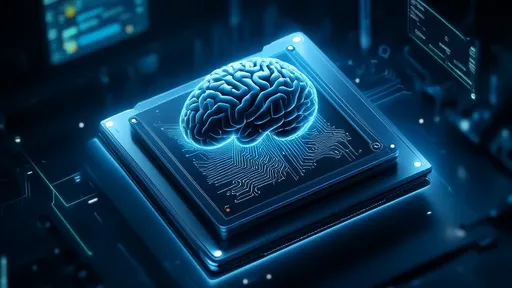
In a groundbreaking fusion of biology and technology, scientists are pioneering a new frontier known as "organoid intelligence" – the use of lab-grown human brain cells to perform computational tasks. This emerging field challenges our traditional understanding of computing by harnessing the innate processing power of living neural networks. Researchers believe these biological systems could eventually complement or even surpass silicon-based computers in certain applications, particularly those requiring adaptive learning and pattern recognition.
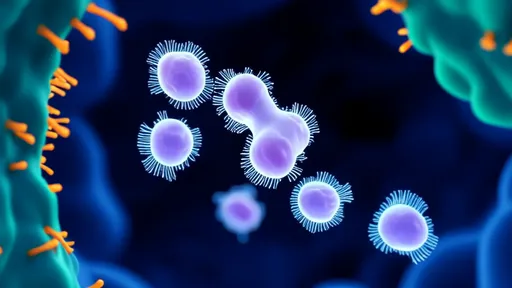
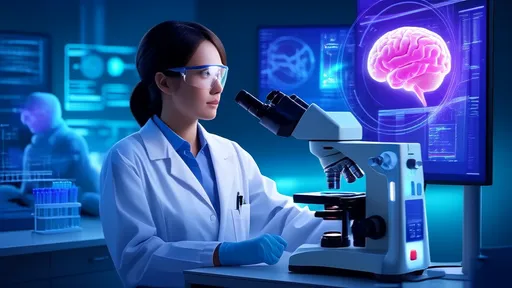
The concept centers around cerebral organoids, three-dimensional clusters of human brain cells cultured from stem cells. These tiny neural structures, no larger than a sesame seed, exhibit spontaneous electrical activity and can form functional synapses. When connected to electrode arrays, these living networks demonstrate an astonishing capacity to process information, adapt to stimuli, and even exhibit rudimentary learning behaviors. Unlike conventional AI which mimics neural processes digitally, organoid intelligence operates through actual biological mechanisms that have evolved over millions of years.
Recent experiments have yielded remarkable results. At several leading institutions, brain organoids have successfully learned to play simplified versions of Pong, recognize speech patterns, and control robotic devices. The systems don't require traditional programming but rather learn through feedback mechanisms, much like biological brains. This capability suggests organoid intelligence may excel at tasks where conventional computers struggle, such as contextual decision-making, sensory integration, and dealing with ambiguous information.
The potential applications span multiple fields. In medicine, neural organoid systems could revolutionize drug testing by providing human-specific responses to pharmaceutical compounds. For neuroscience, they offer unprecedented windows into brain development and neurological disorders. The most tantalizing possibility lies in computing – where organoid intelligence might power a new generation of biohybrid systems combining the best of biological and artificial processing.
Technical challenges remain substantial. Maintaining organoid viability requires precise environmental control, and current systems operate at scales far below mammalian brains. Researchers are working to improve nutrient delivery through innovative microfluidic systems while developing more sophisticated interfaces to communicate with the living networks. Ethical considerations also loom large, as the technology advances toward more complex neural structures that might approach sentience.
As the field progresses, interdisciplinary collaboration has become crucial. Biologists work alongside computer scientists, materials engineers, and ethicists to navigate both the technical and philosophical dimensions of organoid intelligence. Funding initiatives are expanding globally, with both public and private sectors recognizing the transformative potential of this technology.
The coming decade may witness the first practical applications of organoid intelligence in specialized computing tasks. While not replacing conventional computers, these biological systems could find niche applications where their unique capabilities provide decisive advantages. The development represents more than just a new computing paradigm – it forces us to reconsider the fundamental nature of intelligence, both biological and artificial.
Looking ahead, researchers caution that organoid intelligence remains in its infancy. The path from laboratory curiosities to functional computing systems will require numerous breakthroughs. Yet the rapid progress suggests we may be standing at the threshold of a new era in computing – one that blurs the line between living and artificial intelligence in ways previously confined to science fiction.
By /Jul 3, 2025
By /Jul 3, 2025
By /Jul 3, 2025
By /Jul 3, 2025
By /Jul 3, 2025
By /Jul 3, 2025
By /Jul 3, 2025
By /Jul 3, 2025
By /Jul 3, 2025
By /Jul 3, 2025
By /Jul 3, 2025

By /Jul 3, 2025
By /Jul 3, 2025
By /Jul 3, 2025
By /Jul 3, 2025
By /Jul 3, 2025
By /Jul 3, 2025
By /Jul 3, 2025