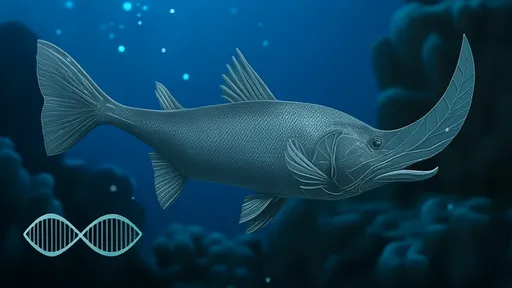
The deep-sea dwelling coelacanth, often referred to as a "living fossil," has long fascinated scientists as a relic of evolutionary history. This enigmatic fish, whose lineage dates back over 400 million years, recently yielded groundbreaking insights into one of life’s most pivotal transitions: the move of vertebrates from water to land. By sequencing and analyzing the coelacanth’s genome, researchers have uncovered key genetic mutations that may have paved the way for this dramatic leap in evolution.
A Genomic Time Capsule
The coelacanth’s genome serves as a unique window into the past. Unlike most ancient species, which exist only as fossils, the coelacanth has survived virtually unchanged for millennia, offering a rare opportunity to study the genetic blueprint of an organism that coexisted with the earliest tetrapods. Recent advancements in genomic sequencing have allowed scientists to compare the coelacanth’s DNA with that of modern terrestrial vertebrates, revealing surprising clues about the genetic toolkit required for life on land.
One of the most striking findings involves genes associated with limb development. The coelacanth possesses primitive versions of genetic sequences that, in land-dwelling vertebrates, govern the formation of limbs, wrists, and fingers. These genes, though not fully developed in the coelacanth, suggest an evolutionary precursor to the limbs that would eventually enable vertebrates to walk on solid ground. Mutations in these genes, researchers hypothesize, could have been a critical step in the transition from fins to limbs.
Breathing Air: A Genetic Switch
Another pivotal discovery centers on respiratory adaptations. For aquatic creatures, extracting oxygen from water is a fundamental biological process, but transitioning to land required the ability to breathe air. The coelacanth’s genome reveals mutations in genes linked to lung development and function—genes that are also found in terrestrial vertebrates but are absent or inactive in most fish. This suggests that the coelacanth’s ancestors may have possessed a latent capacity for air-breathing, which was later refined through natural selection in early tetrapods.
Interestingly, the coelacanth itself does not use lungs for breathing; instead, it relies on gills like other fish. However, the presence of lung-related genes in its genome implies that these genetic pathways existed long before they were co-opted for terrestrial life. This finding challenges previous assumptions that air-breathing evolved independently in multiple lineages and instead points to a shared genetic heritage among vertebrates.
The Role of "Junk DNA"
Beyond protein-coding genes, the coelacanth’s genome has shed light on the importance of non-coding DNA—often dismissed as "junk." Regulatory sequences, which control when and where genes are activated, appear to have played a crucial role in vertebrate evolution. Comparisons with tetrapod genomes show that changes in these regulatory regions, rather than the genes themselves, may have driven the development of land-adapted traits.
For example, subtle mutations in these regulatory regions could have altered the expression of limb-development genes, allowing fins to gradually transform into weight-bearing limbs. Similarly, tweaks to respiratory gene regulators might have enabled the shift from gill-based to lung-based breathing. These insights underscore the idea that evolution often works through fine-tuning existing genetic machinery rather than inventing entirely new genes.
Implications for Evolutionary Biology
The coelacanth’s genome does more than illuminate the past—it also reshapes our understanding of evolutionary processes. By identifying the genetic changes that accompanied the water-to-land transition, scientists can better reconstruct the sequence of events that led to the diversity of life on Earth today. The findings also highlight the importance of "living fossils" in bridging gaps in the fossil record, offering a tangible link to organisms that existed hundreds of millions of years ago.
Moreover, this research has broader implications for studying human evolution. Many of the genes implicated in the coelacanth study are also present in humans, governing everything from limb formation to lung function. Understanding how these genes evolved in early vertebrates provides context for how they operate in our own bodies, offering potential insights into developmental disorders and other medical conditions.
Challenges and Future Directions
Despite these breakthroughs, many questions remain. The coelacanth’s genome is complex, and some of its genetic secrets are still being deciphered. Researchers are particularly interested in how environmental pressures—such as shifting oxygen levels or competition for resources—may have influenced the mutations that enabled terrestrial life. Future studies could explore whether similar genetic changes occurred in other ancient fish lineages or if the coelacanth’s evolutionary path was unique.
Another avenue of research involves comparing the coelacanth’s genome with that of lungfish, another living relic closely related to early tetrapods. Such comparisons could reveal whether the genetic changes observed in the coelacanth were part of a broader evolutionary trend or specific to certain lineages. As sequencing technology continues to advance, scientists hope to uncover even more details about the genetic underpinnings of vertebrate evolution.
A Living Legacy
The coelacanth’s story is a testament to the power of genomics in unlocking evolutionary mysteries. Once thought to be extinct, this ancient fish has emerged as a key player in understanding one of life’s greatest transformations. Its genome, a treasure trove of genetic information, continues to reveal how small mutations can lead to monumental changes—bridging the gap between aquatic and terrestrial life.
As research progresses, the coelacanth will likely remain at the forefront of evolutionary studies, offering new insights into the genetic innovations that shaped the history of life on Earth. Its DNA, a living record of our distant past, reminds us that the secrets of evolution are often hidden in plain sight—waiting to be discovered in the genomes of creatures that time forgot.
By /Jul 3, 2025
By /Jul 3, 2025

By /Jul 3, 2025

By /Jul 3, 2025

By /Jul 3, 2025

By /Jul 3, 2025

By /Jul 3, 2025
By /Jul 3, 2025

By /Jul 3, 2025

By /Jul 3, 2025

By /Jul 3, 2025

By /Jul 3, 2025
By /Jul 3, 2025
By /Jul 3, 2025
By /Jul 3, 2025
By /Jul 3, 2025
By /Jul 3, 2025
By /Jul 3, 2025