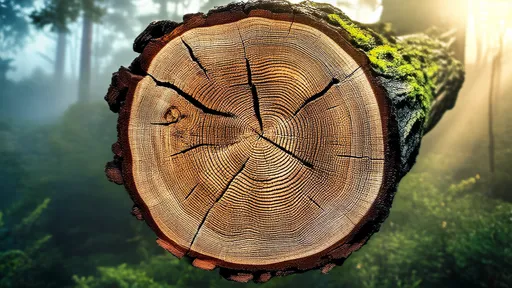
Deep within the silent rings of ancient trees lies a chronicle of our planet's climatic past, written in cellulose and time. Dendrochronologists have long understood that trees serve as nature's most meticulous archivists, recording environmental conditions with astonishing precision. The recent advancements in tree pulse monitoring technology – sophisticated devices that measure the subtle rhythms of tree growth – are revealing startling connections between historical climate patterns and our current ecological crisis.
These arboreal time capsules tell stories far older than any human record. A Douglas fir standing sentinel in Oregon's Cascade Mountains may contain 800 years of drought data within its concentric circles. The gnarled olive trees of Crete whisper of Mediterranean weather shifts across millennia. By extracting core samples and analyzing isotopic signatures, scientists decode narratives of volcanic winters, medieval warm periods, and little ice ages preserved in lignin and sap.
The pulse of living trees offers even more urgent insights. Modern dendrometers attached to trunks like medical monitors detect real-time responses to environmental stress. These instruments reveal how contemporary trees struggle under conditions their ancestors never faced – atmospheric CO2 levels unseen in three million years, erratic precipitation patterns, and rising nocturnal temperatures that disrupt photosynthetic recovery. The data shows temperate zone trees now experience growth rhythms more characteristic of tropical species, a biological anomaly with cascading ecosystem consequences.
High in the Colorado Rockies, bristlecone pines that germinated before the Egyptian pyramids were built now display disturbing growth anomalies. Their cellular records indicate that twentieth-century warming occurred at ten times the average rate of any previous temperature increase captured in their rings. Similar patterns emerge from Siberian larch forests where trees accustomed to -60°C winters now face January thaws and unprecedented insect outbreaks.
Perhaps most alarming are the disappearing rings. In drought-stricken regions from California to Provence, tree cores show entire years where growth virtually stopped – botanical equivalents of famine years in human history. These missing rings correlate with atmospheric pressure anomalies and jet stream deviations that climate models struggle to predict. The trees suggest our current warming trajectory may trigger nonlinear ecological responses that could reshape forests faster than adaptation allows.
The science carries profound implications beyond academia. Insurance companies now consult dendroclimatological records to assess wildfire risks. Winemakers study medieval grape harvest dates preserved in oak beams to anticipate climate impacts on viticulture. Urban planners examine London plane tree rings to understand how megacity heat islands affect vegetation.
Yet these wooden archives face their own existential threat. Ancient trees that survived countless disasters now perish from novel pathogens and extreme weather. The very climate data we need most – how ecosystems respond to abrupt warming – may vanish as old-growth forests decline. Researchers race to core ancient trees before they fall, creating libraries of wooden discs that may outlive the forests they document.
As technological advances allow more precise reading of tree pulses – from laser-measured microcores to AI-assisted ring pattern analysis – the messages grow clearer. The trees tell us current climatic changes exceed natural variability. They warn of tipping points through biochemical signatures of stress. And in their silent way, they question whether human civilization can learn from histories written not in ink, but in xylem and phloem.
The next decade of dendrochronology may reveal whether trees' climate archives will become postmortem autopsies or turnaround stories. As one researcher remarked while coring a 1,200-year-old yellow cedar, "We're not just studying tree rings – we're reading Earth's biography as it's being written." The chapters now being added carry warnings we cannot afford to ignore.

By /Jul 3, 2025

By /Jul 3, 2025

By /Jul 3, 2025

By /Jul 3, 2025

By /Jul 3, 2025

By /Jul 3, 2025

By /Jul 3, 2025

By /Jul 3, 2025

By /Jul 3, 2025

By /Jul 3, 2025

By /Jul 3, 2025
By /Jul 3, 2025
By /Jul 3, 2025

By /Jul 3, 2025

By /Jul 3, 2025

By /Jul 3, 2025

By /Jul 3, 2025

By /Jul 3, 2025